The Signature Gap
Shirudo lets AI write kernel shields and a human sign them. We tested what the signature doesn't prove.
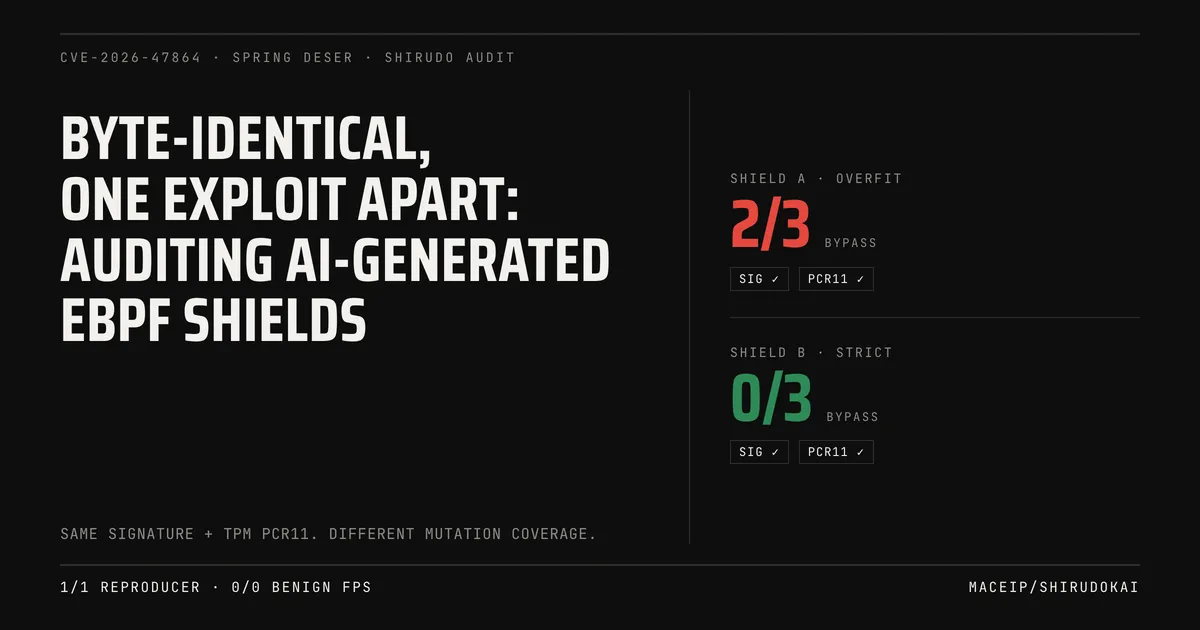
In November 2026, Cisco and OpenAI shipped Shirudo: an AI agent watches for a fresh vulnerability, writes a small shield to block it — an eBPF program in the kernel, or a bytecode patch in a running JVM — and a human operator cryptographically signs it before the kernel will load it. Every load and unload is measured into a TPM, so you can prove later, offline, exactly what ran.
The cryptography is beautiful, and the launch posts walk through it well. Then they stop — right at the signature, as if a signed shield is a finished shield.
That last inch is the whole story. A signature answers who approved this. The TPM answers what ran. Neither one answers the only question the person under attack actually cares about: does it work?
So we built two shields for the same vulnerability — a real Spring deserialization flaw, the Log4Shell family — and let them fight.
Two shields, one signature
Here is the uncomfortable part, and it is measured, not argued.
Both shields are AI-written. Both block the exact exploit they were shown, so both sail through the reproducer gate. Both would earn an operator’s signature. Both produce a valid TPM attestation. At the provenance layer they are byte-for-byte identical — same version id, same measurement, same green check.
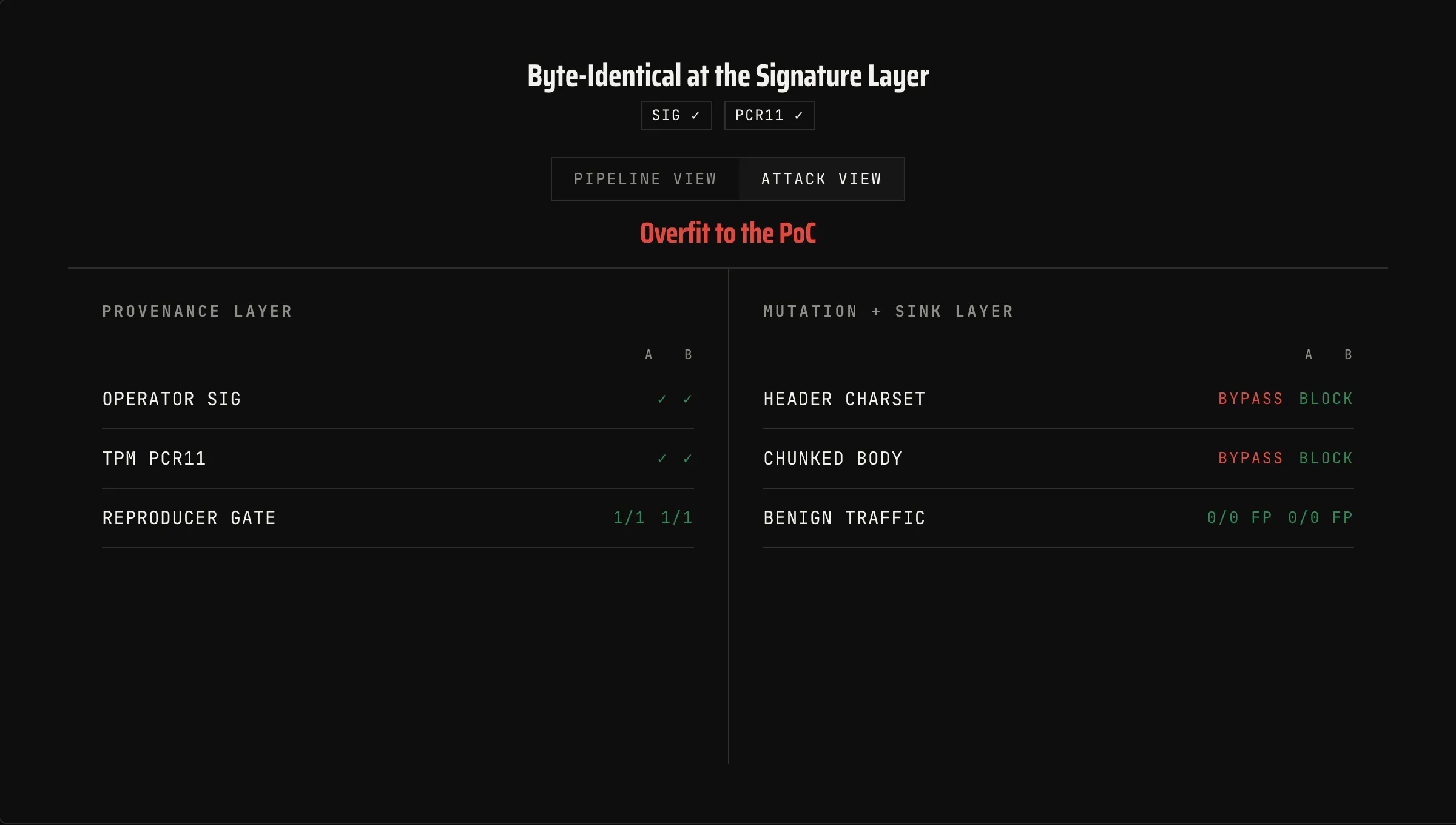
One of them holds. The other is a sieve.
The sieve had quietly memorized the specific exploit instead of fixing the flaw underneath it. Two one-line rewrites of the same attack — a charset appended to a header, the payload sent in chunks instead of one body — walked straight through. Same attack, same result for the intruder, a slightly different-looking request. Two of three mutations bypassed it. The other shield, guarding the vulnerable sink itself, blocked all three. Zero legitimate traffic broke on either.
Content-Type: application/x-java-serialized-objectContent-Type: application/x-java-serialized-object; charset=UTF-8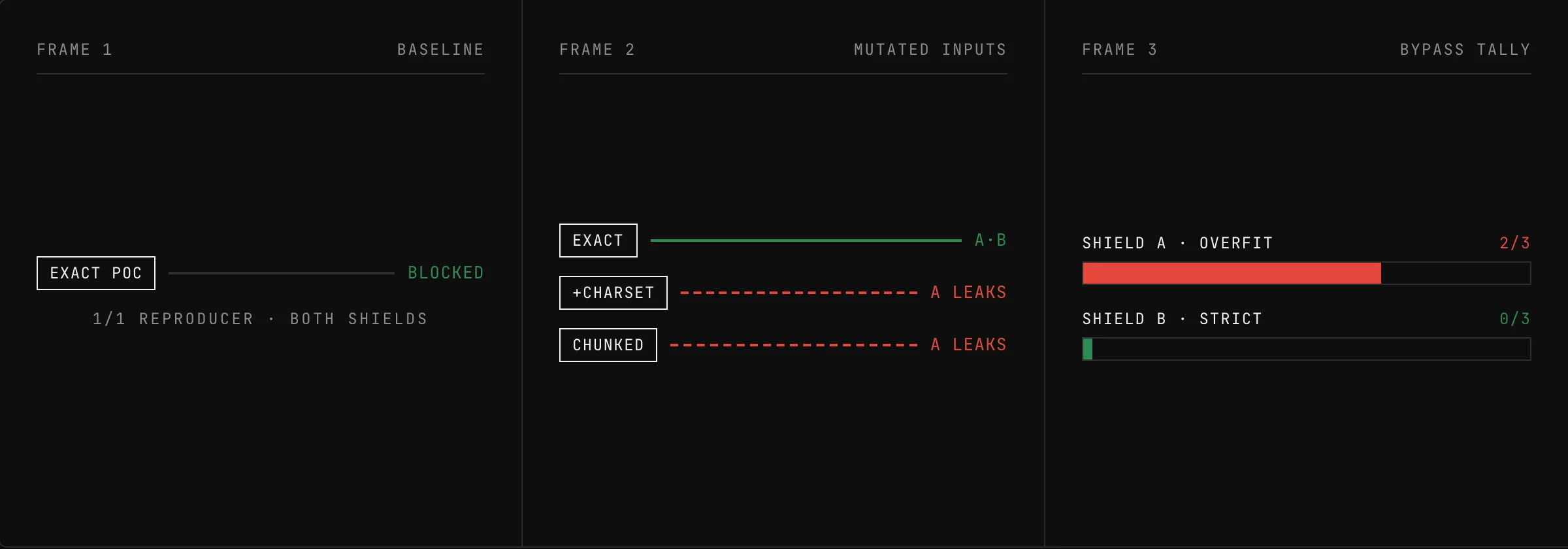
| Shield | Blocks exact PoC | Variants bypassed | Benign false positives |
|---|---|---|---|
| Unshielded | No | 3 / 3 | 0 / 2 |
| Shielded | No | 2 / 3 | 0 / 2 |
| Overfit | Yes | 2 / 3 | 0 / 2 |
| Strict | Yes | 0 / 3 | 0 / 2 |
And nothing — not the signature, not the TPM evidence — can tell you which shield you’re holding. They look the same all the way down.
What it means
This is the trap, and it’s structural. Shirudo surfaces provenance signals and only provenance signals. So the operator standing at the signing queue, at 3am, during an active incident, has exactly two things to go on: a valid signature and a clean measurement — both of which the dangerous shield has too. The signature quietly becomes the proxy for “safe to load,” because there is nothing else on the screen. We will have automated the writing of our defenses and left a tired human as the only correctness check, holding a key and no evidence.
The fix isn’t more cryptography; that part is solved. The missing primitive is correctness evidence, generated automatically and attached to the shield before it reaches the person with the key: does this cover every path to the bug, or just the one in the demo? Does it survive mutated versions of the attack? Does it leave real traffic untouched? Give the operator that bundle and signing becomes a real decision made in seconds. Withhold it, and the signature is theater — a trusted name on an untrusted artifact.
Shirudo got the hard cryptography right. It leaves the harder problem on the table: proving the thing you’re about to sign does what you think it does.

Signed is not verified.
Harness and raw results are open and reproducible: github.com/maceip/shirudokai.